PEG y glicoles
Polietilenglicol (PEG) Grades Guide: propiedades and Aplicaciones
From mobile liquids to high-melting flakes — this guide maps every major PEG grade Venus fabrica to its typical Aplicaciones. Polietilenglicol (CAS 25322-68-3) is a single chemical family spanning molecular weights from approximately 200 to 20,000 g/mol, with physical form and function changing dramatically across that range. Understanding grade nomenclature is the first step toward correct excipient or industrial raw material selection.
En esta página
- How PEG grades are named
- Complete grade overview table
- Liquid grades (PEG 200 – 600)
- Semi-solid grades (PEG 1000 – 3350)
- Solid flake / powder grades (PEG 4000 – 20000)
- Pharma vs technical grade
- Choosing a grade checklist
- Ejemplos de formulación by grade
- PEG history: from 19th-century glycol chemistry to commercial PEG waxes
- Macrogol vs PEG: one chemistry, two naming systems
- PEG in modern biopharmaceuticals: PEGylation
- Custom and blended grades
How PEG grades are named
Polietilenglicol grades are labelled by average molecular weight (PEG 200, 400, 1500, 4000, 8000, etc.). The number is a nominal value — actual average MW falls within a range defined by the fabricante and pharmacopoeial monograph. Higher numbers mean longer polyoxyethylene chains, higher melting points, lower hygroscopicity per unit mass, and generally lower water vapour permeability in films.
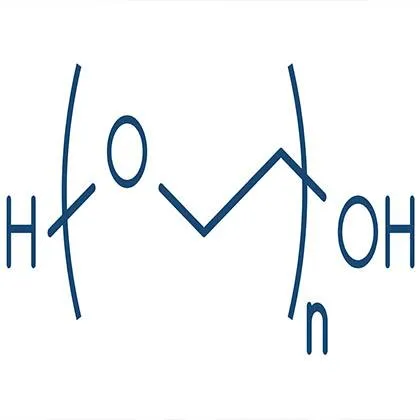
PEG is producido mediante etoxilación of Etilenglicol: each added óxido de etileno unit extends the chain by 44 g/mol. A PEG 400 molecule contains roughly nine óxido de etileno units; PEG 4000 contains roughly ninety. The distribution of chain lengths around the average affects melting range, viscosity, and Rendimiento in demanding Aplicaciones como osmotic laxatives and controlled-release coatings.
Complete grade overview table
| Grade | Physical form (25°C) | Melting range (typical) | Primary Aplicaciones |
|---|---|---|---|
| PEG 200 | Liquid | Very low / liquid | Solvent, antiespumante, coupling agent |
| PEG 400 | Liquid | Very low / liquid | Pharma solvent, cosmetic humectant |
| PEG 600 | Viscous liquid | ~20–25°C | Adhesives, intermediates, base component |
| PEG 1000 | Semi-solid paste | ~38–41°C | Ointment base, suppository component |
| PEG 1500 | Semi-solid | ~44–48°C | Topical bases, cream vehicles |
| PEG 3350 | Flake / powder | ~50–56°C | Osmotic laxative (macrogol 3350) |
| PEG 4000 | Flake / powder | ~50–63°C | Tablet binder, coating, thickener |
| PEG 6000 | Flake / powder | ~55–63°C | Binder, lubricant, anti-redeposition |
| PEG 8000 | Flake / powder | ~60–65°C | Pharma excipient, film coating |
| PEG 12000–20000 | Flake / powder | ~65–75°C | detergentee dispersant, specialty pharma |
Liquid grades (PEG 200 – 600)
Liquid PEG grades serve as solvents, humectants, dispersantes, and coupling agents across pharmaceuticals, cosmetics, and industry. They are completely miscible with water and soluble in many polar organic solvents. Hygroscopicity is highest in this range, which benefits moisture retention in cosmetic gels but requires sealed storage.
Detailed Comparación of the three most common liquids: PEG 200 vs 400 vs 600. For pharmaceutical solubilization, PEG 400 is the most frequently specified. industrial users often select PEG 200 for minimum viscosity.
Semi-solid grades (PEG 1000 – 3350)
PEG 1000 and PEG 1500 appear in ointments, suppositories, and cream vehicles where a melting point near body temperature is desired. These grades are often blended with liquid PEG (400 or 600) and solid PEG (4000 or 8000) to achieve precise consistency and release characteristics.
PEG 3350 — known as macrogol 3350 in pharmacopoeias — is both an excipient and an active pharmaceutical ingredient in osmotic laxative products. It requires tight molecular weight control and low levels of low-MW oligomers. Avesta Pharma fabrica macrogol 3350 under GMP-aligned systems for regulated markets.
Solid flake / powder grades (PEG 4000 – 20000)
Solid PEG grades are white to off-white flakes or free-flowing powders. They function as tablet binders (wet granulation and direct compression), film-coating plasticizers, suppository bases, cosmetic thickeners, and detergentee anti-redeposition agents.
PEG 4000 and 6000: General-purpose binders and thickeners. Used in toothpaste, cosmetic sticks, and ceramic binders alongside pharma Aplicaciones.
PEG 8000: Premium pharmaceutical excipient for oral solid dosage forms — tablet coating, capsule lubrication, and binder Aplicaciones with well-established monograph status.
PEG 12000–20000: Higher melting solids for specialty detergentee dispersantes, ink additives, and Aplicaciones requiring maximum hardness and minimum hygroscopicity.
Pharma vs technical grade
Pharmaceutical grades meet pharmacopoeial limits on identity, purity, heavy metals, óxido de etileno residuals, and related glycol impurities. They are Fabricado under GMP-aligned quality systems with change control, validated methods, and batch traceability. Avesta Pharma supplies macrogol for US, European, and other regulated markets.
Technical grades serve industrial detergenteees, lubricants, metalworking fluids, and chemical synthesis where pharmacopoeial compliance is not required. Venus technical PEG still carries full COA, batch traceability, and consistent molecular weight — at competitive economics for high-volume industrial use.
Choosing a grade checklist
- Required physical form (liquid vs semi-solid vs solid) at use and storage temperature
- Route of administration (pharma) or industrial exposure limits
- Compatibility with actives, preservatives, and packaging materials
- Target viscosity, melting point, or dissolution rate
- Regulatory monograph (USP, Ph. Eur., IP, JP) and customer qualification requirements
- Hygroscopicity tolerance — liquid grades absorb moisture readily; high-MW solids are more forgiving
- Processing method — wet granulation, hot-melt extrusion, melt casting, or liquid fill
Ejemplos de formulación by grade
| Formulación type | PEG grade(s) | Function |
|---|---|---|
| Oral solution solubilizer | PEG 400 | Dissolve lipophilic API |
| Topical ointment | PEG 400 + PEG 4000 | Melt-on-skin vehicle |
| Tablet wet granulation | PEG 6000 / 8000 | Binder in granulating liquid |
| Film coating plasticizer | PEG 8000 | Flexibility and adhesion |
| Osmotic laxative powder | PEG 3350 | Active ingredient |
| Laundry anti-redeposition | PEG 6000 | Soil suspension aid |
For Fabricación background, see PEG Fabricación in India. For estabilidad considerations in drug products, read PEG in pharmaceutical formulaciones.
Request TDS and samples via contact or explore detailed grade pages on our Polietilenglicol product hub.
PEG history: from 19th-century glycol chemistry to commercial PEG waxes
Polietilenglicol was first produced in 1859, when Portuguese chemist A. V. Lourenço heated Etilenglicol with ethylene dibromide and isolated the resulting oligomers by fractional distillation — French chemist Charles-Adolphe Wurtz reported closely related glycol chemistry at almost the same time. Both discoveries sat as laboratory curiosities for decades; the compound had no significant commercial role until Dow Chemical launched a commercial polyethylene glycol line in 1940 as a water-soluble wax substitute, giving industry its first standardized, commercially produced PEG line. From that starting point, PEG expanded rapidly into pharmaceuticals, cosmetics, and industrial chemistry over the following decades as Fabricantes learned to control molecular weight distribution precisely enough for demanding Aplicaciones — culminating, in the 1990s, in the use of high-purity PEG 3350 as an osmotic laxative that transformed treatment of chronic constipation and remains one of the highest-volume single pharmaceutical uses of the polymer today.
Macrogol vs PEG: one chemistry, two naming systems
formuladores new to PEG sourcing are sometimes confused to see the same molecule listed under two names on different documents. "Macrogol" is the International Nonproprietary Name used throughout the European, Japanese, and other international pharmacopoeias, while "Polietilenglicol" and "PEG" remain the standard terms in the US Pharmacopoeia, the broader chemical industry, and cosmetic ingredient listings. The number following either name — macrogol 400 or PEG 400 — refers to the same nominal average molecular weight; regulatory submissions in Europe should reference the macrogol monograph name even when the technical data sheet uses PEG nomenclature, since compendial testing and acceptance criteria are indexed under that name.
PEG in modern biopharmaceuticals: PEGylation
Beyond its long-standing role as an excipient, PEG chemistry has found an entirely separate modern application in biopharmaceuticals: PEGylation, the covalent attachment of PEG chains to protein or peptide drugs to extend circulation time in the body, reduce immunogenicity, and improve solubility. This use employs specialized, narrowly-defined, activated PEG derivatives rather than the general-purpose excipient and industrial grades covered in the table above, and sits under separate biologics regulatory pathways with far more stringent purity and characterization requirements than pharmacopoeial macrogol monographs. It is a useful reminder for procurement teams that "PEG" spans an unusually wide range of quality tiers — from technical-grade industrial flakes at one end to activated PEGylation reagents at the other — and that selección de grados should always be driven by the specific regulatory pathway and application, not by molecular weight number alone. Venus focuses on pharmacopoeial and industrial PEG grades rather than activated PEGylation reagents, and can direct biologics customers to the appropriate specialty suppliers when that narrower chemistry is required.
Custom and blended grades
Venus can supply custom average molecular weights and physical forms for specialty Aplicaciones. Blends of two or more PEG grades are common in Formulación development — our equipo técnico supports melting point calculations and compatibility screening. With 90,000 MT group capacity and 24/7 R&D, we scale from pilot batches to commercial volumes.