PEG e glicóis
How Polietilenglicol Improves estabilidad of Pharmaceutical and Cosmetic formulaciones
PEG is not only a solvent — it actively shapes shelf life, appearance, and bioavailability of finished dosage forms and cosmetic products. Polietilenglicol (CAS 25322-68-3) functions across multiple excipient roles simultaneously: solubilizing lipophilic actives, plasticizing film coats, controlling moisture flux, and providing chemically stable vehicles for sensitive APIs. This guide explains how selección de grados and Formulación design leverage PEG to improve product estabilidad.
Nesta página
- PEG as a multifunctional excipient
- Solubility and chemical estabilidad of actives
- Moisture management and hygroscopicity
- Physical estabilidad of semisolids
- Tablet film coating and solid oral estabilidad
- Cosmetic Formulación estabilidad
- Regulatory and quality considerations
- estabilidad testing recommendations
- Background: what Polietilenglicol is and how it is made
- Working with Venus and Avesta Pharma
PEG as a multifunctional excipient
In pharmaceuticals, Polietilenglicol functions as solvent, plasticizer, binder, film-forming agent, ointment base, and suppository matrix. In cosmetics it acts as humectant, emollient, solubilizer, and viscosity modifier. These roles directly affect Formulación estabilidad — chemical, physical, and microbiological.
Unlike many excipients that serve a single function, PEG can simultaneously improve API solubility, protect against moisture ingress, and provide a chemically inert environment that minimizes degradation pathways como hydrolysis and oxidation. The key is matching molecular weight and grade purity to the dosage form, packaging, and storage conditions.
Solubility and chemical estabilidad of actives
Many APIs are poorly water-soluble. PEG 400 and similar liquid grades dissolve or molecularly disperse lipophilic actives, preventing precipitation during storage. A stable molecular dispersion reduces phase separation, content uniformity failures, and crystallization upon temperature cycling.
In solid dispersion systems, high-MW PEG (PEG 6000, 8000) acts as a hydrophilic carrier that enhances dissolution rate while maintaining the amorphous or molecularly dispersed state of the API. Hot-melt extrusion and melt granulation with PEG carriers are established approaches for bioavailability enhancement. The estabilidad of the dispersion depends on PEG molecular weight, API loading, and storage humidity.
PEG itself is chemically stable — resistant to hydrolysis at pharmaceutical pH ranges and temperatures. It does not support microbial growth in anhydrous or high-PEG systems, though aqueous PEG solutions require standard preservation where water activity supports growth.
Moisture management and hygroscopicity
PEG's hygroscopicity can protect or challenge estabilidad Según grade and packaging. Liquid and low-MW PEG grades absorb atmospheric moisture readily, which can be beneficial in topical gels that must maintain water content but problematic in solid dosage forms if uncontrolled moisture uptake softens coatings or promotes API degradation.
In creams and lotions, PEG helps maintain water activity and uniform phase distribution. In solid doses, moisture-barrier coatings incorporating PEG-based film formers (often combined with polymers como HPMC) reduce moisture ingress through blister or bottle closures. Matching grade to primary packaging — HDPE, glass, aluminium blister — is critical for long-term estabilidad.
| PEG grade | Moisture behaviour | estabilidad implication |
|---|---|---|
| PEG 400 (liquid) | Highly hygroscopic | Seal containers; monitor water content in solutions |
| PEG 1500–3350 | Moderately hygroscopic | Control RH during processing and storage |
| PEG 8000 (solid) | Lower hygroscopicity | Preferred for tablet coating; less moisture uptake |
| PEG 20000 | Lowest hygroscopicity | Stable solid; slow moisture equilibration |
Physical estabilidad of semisolids
Ointment and gel bases using PEG 1500–4000 blends provide consistent melting and spreading profiles across temperature cycles — reducing bleeding, syneresis, and phase separation in topical products. The eutectic behaviour of PEG blends allows formuladores to design vehicles with melting points at or just above skin temperature for comfortable application.
Physical estabilidad also depends on compatibility with other excipients. PEG is compatible with most common preservatives, gelling agents, and emulsificantes used in topical pharmaceuticals and cosmetics. Incompatibility with certain phenolic antioxidants has been reported in specific systems — compatibility screening during development is recommended.
Tablet film coating and solid oral estabilidad
PEG 4000 and 8000 in coating systems improve flexibility and adhesion of film coats, protecting cores from moisture, light (when combined with opacifiers), and mechanical abrasion. Plasticized films are less prone to cracking during drying and shipping — a common cause of moisture ingress and subsequent API inestabilidad.
Multilayer and extended-release designs rely on controlled PEG molecular weight distribution to tune drug release kinetics. Higher-MW PEG melts at higher temperatures and contributes differently to pore formation in matrix systems en comparación con low-MW fractions. Narrow molecular weight distribution — as supplied by Avesta Pharma for pharmacopoeial grades — improves batch-to-batch coating consistency.
Cosmetic Formulación estabilidad
In cuidado pessoal products, PEG 400 and related grades stabilize fragrance oils, essential oil blends, and lipophilic active ingredients in aqueous systems. As humectants, they reduce water loss from emulsions and gels, maintaining texture and preventing "skinning" on the product surface during shelf life.
See Venus cuidado pessoal Aplicações for compatible chemistries. PEG-derived emulsificantes and PEG itself often appear together in cream and lotion systems where estabilidad against phase separation is essential.
Regulatory and quality considerations
Use pharmacopoeial-grade PEG with COA showing compliance to USP, Ph. Eur., or IP limits. Venus subsidiary Avesta Pharma supplies macrogol for regulated markets with GMP-aligned Fabricación, validated analytical methods, and documented estabilidad of the excipient itself.
Analytical support includes hydroxyl number (molecular weight confirmation), moisture, pH, colour, residual óxido de etileno, peroxide value, and heavy metals within specification. Customers qualifying Avesta macrogol receive documentation supporting regulatory submissions and excipient master file cross-references where available.
Explore PEG 8000, full PEG portfolio, and quality systems. For selección de grados background, see the PEG grades guide and Fabricación overview.
estabilidad testing recommendations
When PEG is a major Formulación component, ICH-aligned estabilidad studies should include:
- Water content monitoring (Karl Fischer) at each time point
- Visual appearance and phase separation assessment for semisolids
- Dissolution and content uniformity for solid dispersions
- Coating integrity (cracking, peeling) for film-coated tablets
- Microbial limits testing for aqueous PEG solutions and creams
- Packaging interaction — extractables from containers in contact with liquid PEG
Accelerated conditions (40°C/75% RH) stress hygroscopic PEG systems effectively. For solid PEG coatings, thermal cycling between low and high temperature reveals film brittleness that may not appear under constant accelerated storage.
Background: what Polietilenglicol is and how it is made
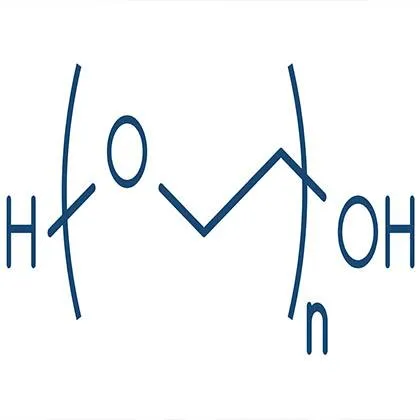
Polietilenglicol is the common name for a family of polyether compounds producido mediante the ring-opening polymerization of óxido de etileno, typically initiated with water or a low-molecular-weight glycol under basic catalysis. The general structure H–(O–CH2–CH2)n–OH means that PEG grades are distinguished not by a single molecule but by average molecular weight, expressed in the grade number — PEG 400 has an average molecular weight near 400 g/mol, while PEG 8000 averages around 8,000 g/mol. Low-molecular-weight grades (up to roughly PEG 600) are clear, water-miscible liquids at room temperature; intermediate grades are soft pastes; and high-molecular-weight grades (PEG 3350 and above) are waxy, free-flowing solids. industrially, óxido de etileno is itself Fabricado by the catalytic oxidation of ethylene, a process refined through the twentieth century by companies como Union Carbide, Dow, and Shell as óxido de etileno derivatives — including glycols, glycol ethers, and etoxilatos — grew into a major branch of petrochemical and oleochemical Fabricación.
In pharmacopoeial and regulatory contexts, PEG is frequently called macrogol, a name that reflects the same polymer family described by molecular weight (e.g., Macrogol 400, Macrogol 4000). The Ph. Eur. and other pharmacopoeias use "macrogol" as the official monograph name, while USP and common commercial usage favour "PEG" or "Polietilenglicol." Both terms describe chemically identical polymer classes and formuladores should treat the nomenclature as interchangeable once molecular weight grade is specified.
Beyond pharmaceutical excipient roles, PEG chemistry underpins several other well-known Aplicações that illustrate the versatility of the polymer backbone. High-molecular-weight PEG is used as an osmotic laxative and bowel-preparation agent because it is poorly absorbed and retains water in the gastrointestinal tract. In biotechnology, covalent attachment of PEG chains to proteins and antibody fragments — a process called PEGylation — extends circulating half-life and reduces immunogenicity, a technique behind several approved biologic therapeutics. PEG is also used industrially as a cryoprotectant, a lubricant carrier, and a component of certain polymer electrolytes, reflecting the same core propiedades — solubilidad en agua, low toxicity, and chemical inertness — that make it valuable in pharmaceutical Formulación.
Working with Venus and Avesta Pharma
Venus Ethoxyethers and Avesta Pharma support formuladores with technical data, samples, and estabilidad-related analytical services. Our 24/7 R&D team assists with selección de grados, blend optimization, and compatibility screening. Contact us via reach us for project-specific support.