Émulsifiants
The HLB Scale: A formulador's Guide to Émulsifiant Selection
The Hydrophile–Lipophile Balance (HLB) system, developed by William Griffin in the late 1940s, remains one of the most practical tools for matching émulsifiants to oils, waxes, and lipophilic actives. While it does not replace estabilidad testing, HLB gives formuladores a rational starting point for Émulsifiant selection instead of exhaustive trial-and-error. This guide explains the 0–20 scale, lists required HLB values for common oils, walks through three worked Ejemplos de formulación, and discusses limitations where experience and testing must take over. Venus Ethoxyethers fabrique non ionique émulsifiants across the full HLB range from Éthoxylation facilities in Inde and the Estados Unidos, with 30+ years of Formulación support experience.
Sur cette page
- Qué es HLB?
- Required HLB: matching émulsifiants to the oil phase
- Calculating blend HLB
- Worked example 1: O/W hand cream
- Worked example 2: agroquímico EC dilution
- Worked example 3: Fragrance solubilization
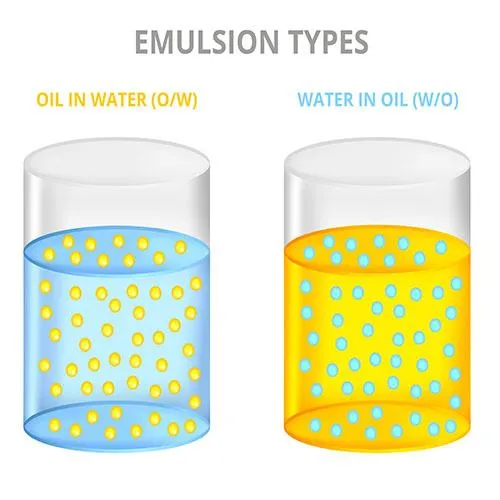
- HLB for W/O emulsions
- History and development of the HLB concept
- Limitations and practical tips
Qué es HLB?
HLB is a relative scale from 0 (fully lipophilic) to 20 (fully hydrophilic). non ionique tensioactifs with long óxido de etileno chains sit at the high end; sorbitan monoesters with little or no EO sit at the low end. The number represents the balance between the hydrophilic and lipophilic portions of the molecule and correlates with the type of emulsion a tensioactif will favour.
Griffin's original method calculates HLB for éthoxylated non ioniques from molecular weight ratios. In practice, formuladores use published HLB values for commercial grades and blend two or more émulsifiants to achieve a target system HLB.
| HLB range | Behaviour | Example tensioactifs |
|---|---|---|
| 1–3 | Antifoam, W/O Émulsifiant | Sorbitan oleate, lanolin derivatives |
| 4–6 | W/O Émulsifiant | Sorbitan stearate , glycerol monooleate |
| 7–9 | Wetting, dispersing | Alcool gras éthoxylate (low EO) |
| 8–18 | O/W Émulsifiant | Polysorbate 80, C12–C18 alcohol éthoxylates |
| 13–15 | detergentee, solubilizer | Polysorbate 20, high-EO FAE |
| 15–18 | Solubilizer, micellar | Polysorbate 20, PEG-40 Huile de ricin |
Required HLB: matching émulsifiants to the oil phase
Each oil, wax, or lipophilic active has a required HLB — the system HLB at which it is most easily emulsified in an O/W system. When the Émulsifiant system HLB matches the required HLB of the oil phase, emulsions form more readily and tend to be more stable. Required HLB is determined experimentally and published in Formulación handbooks; values below are representative guides.
| Oil / wax | Required HLB (O/W) | Example application |
|---|---|---|
| Mineral oil | 10–11 | trabajo de Métales fluid O/W emulsion |
| Huile de ricin | 14 | agroquímico EC dilution |
| Vegetable oil (soy/sunflower) | 7–8 | Salad dressing, neem EC |
| Lanolin | 12 | Pharmaceutical ointment |
| Beeswax | 9 | Cosmetic cream |
| Silicone oil | 10.5 | Silicone emulsion polish |
| Isopropyl myristate | 11 | Cosmetic emollient emulsion |
| Paraffin wax | 10 | Candle and polish emulsions |
Calculating blend HLB
When blending two or more émulsifiants, system HLB is the weighted average:
System HLB = (fraction A × HLB A) + (fraction B × HLB B) + …
Example: 70% Polysorbate 60 (HLB 14.9) + 30% Sorbitan stearate (HLB 4.7) gives 0.7 × 14.9 + 0.3 × 4.7 = 10.4 + 1.4 = 11.8. This is close to the required HLB of mineral oil (10–11) and suitable for an O/W cream containing mineral oil in the oil phase.
Worked example 1: O/W hand cream
Formula target: 15% oil phase (cetyl alcohol + mineral oil), O/W emulsion, stable at 40°C storage.
Step 1: Calculate weighted required HLB of oil phase. Mineral oil (required HLB ~10.5) at 10% plus cetyl alcohol (required HLB ~15) at 5% gives weighted required HLB ≈ 11.
Step 2: Blend émulsifiants to system HLB 11 — e.g. 70% Polysorbate 60 (HLB 14.9) + 30% Sorbitan stearate (HLB 4.7) → calculated system HLB ≈ 11.8.
Step 3: Use 4–5% total Émulsifiant on formula weight. Heat aceite et agua phases separately to 75°C, combine with homogenization, and cool with gentle stirring.
Step 4: Adjust viscosity with 0.1–0.3% electrolyte or 0.5% xanthan gum if needed. Run 40°C / 75% RH estabilidad for 4 weeks minimum.
Worked example 2: agroquímico EC dilution
An emulsifiable concentrate containing 50% actives in aromatic solvent must disperse into hard water at 1:500 dilution without creaming or oil separation.
- Target Émulsifiant system HLB 10–12 for the solvent/actives blend.
- Blend calcium dodecylbenzene sulfonate (hydrotrope/wetting aid) with C9–C11 alcohol éthoxylate (5 EO) at approximately 1:1 ratio.
- Total Émulsifiant package typically 8–15% of the EC formula.
- Test CIPAC 36.1 dilution estabilidad at 0°C, 20°C, and 54°C before registration.
See also our emulsifiable concentrates guide for EC Formulación principles.
Worked example 3: Fragrance solubilization
To clear-solubilize 1% perfume oil in an aqueous toner without cloudiness:
- Use Polysorbate 20 (HLB ~16.7) at a minimum 3:1 tensioactif-to-oil ratio — i.e. 3% PS 20 for 1% fragrance.
- Pre-mix fragrance with polysorbate before adding to water.
- Increase ratio to 4:1 or 5:1 for difficult terpene-rich or resinous oils.
- If clarity is marginal, add 0.5–1% ethanol as co-solvent.
HLB for W/O emulsions
W/O emulsions require low-HLB émulsifiants in the 3–6 range. A water-in-mineral-oil Formulación might use sorbitan oleate (HLB ~4.3) or glycerol monooleate (HLB ~3.8) as the primary Émulsifiant, possibly with a low-EO Alcool gras éthoxylate as co-Émulsifiant. The required HLB concept still applies but targets the W/O side of the scale.
History and development of the HLB concept
The HLB system was introduced in 1949 by William C. Griffin, a chemist working at Atlas Powder Company (later absorbed into ICI Americas), who needed a systematic way to rank the growing number of sorbitan-ester and polysorbate émulsifiants the company was commercializing. Griffin's original paper, published in the Journal of the Society of Cosmetic Chemists, proposed a simple arithmetic method: for Acide gras esters, HLB = 20 × (1 − S/A), where S is the saponification number of the ester and A is the acid number of the Acide gras. For tensioactifs where saponification is not straightforward, Griffin offered an alternative based on the weight percentage of the hydrophilic portion of the molecule divided by five, capping the practical scale at 20.
In 1957, Australian chemist Norman Davies extended the concept with a group-contribution method that assigns numerical values to specific chemical groups — sulfate, carboxylate, ether oxygen, hydroxyl — and sums them to estimate HLB directly from molecular structure. The Davies method was a significant advance because it could be applied to ionic tensioactifs that Griffin's original saponification approach could not handle well, broadening HLB's usefulness beyond the non ionique esters it was originally designed for.
A related but distinct approach is the phase inversion temperature (PIT) method developed by Kozo Shinoda in the 1960s. Rather than assigning a fixed number to a tensioactif, PIT identifies the temperature at which an O/W emulsion inverts to W/O as the non ionique Émulsifiant's hydrophilicity decreases with rising temperature. PIT-based Formulación is largement utilizados alongside HLB in cosmetic and industriel emulsion design, particularly for systems stabilized by éthoxylated non ioniques whose solubility is strongly temperature-dependent. Modern formuladores often combine HLB for initial Émulsifiant screening with PIT or direct estabilidad testing for final optimization, since no single number fully captures real-world emulsion behaviour.
Limitations and practical tips
HLB is a starting point, not a guarantee of emulsion estabilidad. Real-world behaviour is also affected by:
- Temperature — punto de turbidez and emulsion viscosity change with temperature; a stable room-temperature emulsion may separate at 40°C.
- Electrolytes — salts compress the electrical double layer and can break O/W emulsions or invert them.
- pH — ionic émulsifiants change charge state; ester-based émulsifiants may hydrolyse at extreme pH.
- Co-tensioactifs and thickeners — alcools gras, waxes, and polymers build viscosity and gel network estabilidad beyond what HLB alone predicts.
- Phase volume ratio — high internal phase emulsions need more Émulsifiant than dilute systems.
Always validate with accelerated estabilidad testing and application-specific Rendimiento tests. For complex systems, Venus technical support can recommend Alcool gras éthoxylates, polysorbates, and custom Émulsifiant blends. Read tensioactif vs Émulsifiant for context on when HLB applies. Contacte Avec Venus for samples and HLB matching support.