Surfactants
Alkyl-Capped and Methyl-Capped Surfactants
End-capping blocks the terminal hydroxyl group of an ethoxylate chain with a methyl or longer alkyl substituent, fundamentally altering hydrogen bonding with water at the surfactant tail. The result is lower foam, modified cloud point behaviour, improved wetting above cloud point in some systems, and better performance in high-temperature spray cleaning and recirculating metalworking fluids. Alkyl-capped and methyl-capped surfactants are specialty nonionics derived from standard alcohol ethoxylates through a secondary alkylation or methylation step. Venus Ethoxyethers manufactures end-capped grades from dedicated alkoxylation and capping lines in Goa, India, for metal processing, CIP cleaning, paper, and low-foam institutional applications.
On this page
- What is end-capping?
- Capped vs uncapped performance
- How methyl capping reduces foam
- Performance benefits in industrial systems
- Grade selection by application
- Applications in detail
- Worked formulation examples
- Capped ethoxylates vs EO/PO block copolymers
- Cap efficiency, COA items, and foam troubleshooting
- Manufacturing at Venus Ethoxyethers
- Environmental and handling notes
- Related guides and products
What is end-capping?
Standard fatty alcohol ethoxylates terminate in a primary hydroxyl group (–CH₂CH₂OH) that hydrogen-bonds strongly with water. This hydroxyl promotes water solubility, raises cloud point, and stabilizes foam through enhanced surface elasticity at the air–water interface. In applications where foam is undesirable — recirculating coolant systems, spray washing, CIP pipelines under turbulent flow — that terminal hydroxyl becomes a liability.
Methyl capping replaces the terminal –OH with –OCH₃ via reaction of the ethoxylate with dimethyl sulfate, methyl chloride, or methyl tosylate under alkaline catalysis. The ether linkage is stable under normal use conditions and eliminates one hydrogen-bond donor site. Alkyl capping uses longer alkyl halides or sulfates to introduce C4–C12 end groups, further increasing hydrophobic character and depressing foam beyond what methyl capping alone achieves.
Capping reduces foam by limiting surfactant–water hydrogen bonding at the chain end and by altering the packing geometry at the micelle surface. It can also narrow homologue distribution in certain manufacturing routes, producing more consistent cloud point and wetting performance batch to batch.
Capped vs uncapped performance
| Property | Uncapped alcohol ethoxylate | Methyl-capped | Alkyl-capped |
|---|---|---|---|
| Foam volume | High to moderate | Low to moderate | Very low |
| Cloud point (same EO) | Higher | Lower | Lower still |
| Wetting above cloud point | Poor (phase separates) | Improved | Often excellent |
| Relative cost | Baseline | Moderate premium | Higher premium |
| Biodegradability | Excellent | Good | Good (chain dependent) |
How methyl capping reduces foam
Foam stability depends on a viscoelastic surface film that resists drainage and rupture. The terminal hydroxyl of uncapped ethoxylates participates in hydrogen bonding with adjacent water molecules and surfactant head groups, reinforcing this film. Blocking the hydroxyl with a methyl ether (–OCH₃) removes that bonding site, weakening the surface film and accelerating foam collapse under shear — exactly the behaviour needed in agitated recirculating systems and high-pressure spray nozzles.
Importantly, capping does not eliminate surfactant activity. Capped ethoxylates still lower surface tension, emulsify tramp oil, and wet metal surfaces. They simply do so without generating stable foam that would overflow sumps, cavitate pumps, or leave foam residues on cleaned parts.
Cloud point depression from capping means the surfactant may remain as a dispersed phase above its nominal cloud point while still wetting effectively — a useful property in hot alkaline cleaning where uncapped nonionics would phase-separate and lose detergency.
Performance benefits in industrial systems
Capped ethoxylates deliver several advantages over uncapped equivalents at the same fatty chain length and EO level. Lower foam reduces antifoam chemical demand and prevents sump overflow in machining centres. Stable wetting above cloud point in some systems allows operation at 50–80°C without losing surface activity. Penetration into complex geometries — blind holes, threaded features, fine clearances — improves because low-foam systems do not trap air pockets in foam barriers.
Capped products can be combined with EO/PO block copolymers for further foam control and temperature behaviour tuning. The choice between capped ethoxylates and EO/PO blocks depends on cost target, cloud point specification, and compatibility with electrolyte level in the working fluid.
Grade selection by application
| Application | Chain length | EO moles | Cap type |
|---|---|---|---|
| Metalworking coolant (sump) | C9–C11 | 6–8 | Methyl |
| Spray parts washer | C9–C11 | 5–6 | Methyl or butyl |
| Brewery CIP (caustic) | C12–14 | 7–9 | Methyl |
| Paper pulp washing | C12–14 | 5–7 | Alkyl |
| Hard-surface spray cleaner | C9–C11 | 4–5 | Methyl |
| Alkaline degreasing | C12–14 | 6–8 | Methyl + EO/PO co-blend |
Applications in detail
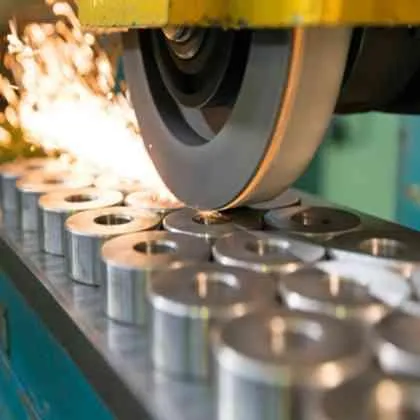
Metal working fluids: Capped C9–C11 ethoxylates wet ferrous and aluminium parts at 40–60°C with minimal foam in recirculating systems. They emulsify tramp oil from slideway lubricants and remove fine metal fines from grinding operations. Compatibility with biocide packages and hard water must be verified; capped nonionics generally tolerate moderate electrolyte better than anionic emulsifiers in synthetic coolants.
CIP cleaning: Brewery, dairy, and pharmaceutical pipeline cleaning under turbulent caustic flow demands low-foam wetting agents. Methyl-capped C12–14 ethoxylates at 0.5–2 g/L in sodium or potassium hydroxide solutions provide detergency without foam that would interfere with pressure sensor readings or CIP return flow measurement. See CIP and machine dishwashing guide.
Paper processing: Controlled foam in pulp washing reduces defoamer consumption and improves drainage on the wire. Alkyl-capped grades combined with silicone defoamers give synergistic foam control in kraft and recycled fibre lines.
Institutional spray cleaning: Floor and hard-surface spray-and-vac systems benefit from capped wetters that clean without leaving foam residue. Pair with alkali-stable surfactants when formulations are alkaline.
Textile scouring (low-foam): Jet and overflow machines where foam interferes with fabric circulation use capped ethoxylates instead of standard FAE at equivalent EO level.
Worked formulation examples
Synthetic metalworking fluid (dilutable):
- 15% methyl-capped C9–C11, 6 EO (primary emulsifier/wetter)
- 5% emulsifiable oil or ester lubricity agent
- 2% triethanolamine (pH buffer, rust inhibition)
- 1% boric acid complex
- 0.5% biocide; dilute 5–10% in water for sump use
- Operate 35–45°C; foam collapse within 30 seconds in agitation test
Brewery caustic CIP detergent:
- 2% potassium hydroxide (as KOH, pH 12–13)
- 0.8% methyl-capped C12–14, 7 EO
- 0.3% EO/PO block copolymer (supplementary low-foam wetting)
- 0.2% EDTA or gluconate sequestrant
- Circulate 65–75°C for 20–30 minutes; verify rinse conductivity endpoint
Low-foam spray degreaser:
- 3% methyl-capped C9–C11, 5 EO
- 1% sodium metasilicate (builder)
- 0.5% sodium xylene sulfonate (hydrotrope)
- Spray at 50–60°C on machined aluminium; rinse with DI water
Paper pulp washing aid:
- 0.3–0.8 kg/tonne alkyl-capped C12–14, 6 EO
- Added to washer shower water before fine screening
- Combine with 0.1% silicone emulsion defoamer if needed
Capped ethoxylates vs EO/PO block copolymers
Both chemistries address low-foam requirements but through different mechanisms. Capped ethoxylates retain the alcohol-initiated linear polyoxyethylene structure with only the terminal group modified — they behave similarly to parent FAE in emulsification and soil removal but with depressed foam. EO/PO block copolymers have fundamentally different structure (propylene oxide blocks increase hydrophobicity in segments) and offer independent control of foam and cloud point through PO content.
Capped ethoxylates are often lower cost per active kg and biodegrade through pathways similar to standard alcohol ethoxylates. EO/PO blocks excel when very low foam at temperatures above 80°C is required or when dynamic foam control across a wide temperature range is needed. Many industrial formulations blend both at 1:1 to 2:1 ratio for cost-performance optimization.
Cap efficiency, COA items, and foam troubleshooting
Buy end-capped grades on cap efficiency, not cloud point alone. Residual uncapped ethoxylate is the usual reason a low-foam lot suddenly Ross-Miles like the parent fatty alcohol ethoxylate: hydroxyl value that has not fallen versus the uncapped intermediate, or NMR or HPLC cap efficiency below the qualification lot, predicts foam rebound in spray CIP and recirculating metal fluids. COA fields that correlate with plant behaviour are hydroxyl value, cloud point in a stated electrolyte, pH of a 1% solution, colour, water, and foam height at a defined temperature. If foam collapses in the laboratory at 25°C but floods a 70°C spray washer, the cloud point may sit inside the operating window so the surfactant oils out and the remaining uncapped fraction foams. Hard-water calcium can restore foam by tightening interfacial films; add sequestrant before swapping chemistry. Over-capping or residual alkylating agent is a manufacturing control issue, not a formulator adjustment — incoming lots should be free of dimethyl sulfate or alkyl halide above the agreed detection limit. Keep the qualification foam curve with a retained sample; a 20% rise in foam height at the same dose is usually cap-efficiency drift, not a builder change.
Manufacturing at Venus Ethoxyethers
Venus produces end-capped surfactants from integrated ethoxylation and capping operations. Base alcohol ethoxylates are manufactured in pressurized reactors; capping is performed as a downstream step with strict control of reagent stoichiometry to maximize cap efficiency and minimize residual uncapped material. Quality parameters include hydroxyl value (reduced versus uncapped), cloud point, foam height (Ross-Miles or equivalent), and cap efficiency by NMR or HPLC where required.
Product pages: alkyl capped surfactants, methyl capped surfactants, and end-capped products. Custom chain lengths, EO levels, and cap types are available for toll and contract customers.
With 90,000 MT group alkoxylation capacity from Goa, India, Venus supports metal, paper, food-processing, and I&I formulators globally. Request foam screening, cloud point verification, and hard-water compatibility data via contact Venus Ethoxyethers.
Environmental and handling notes
Methyl-capped ethoxylates biodegrade under aerobic conditions; the methyl ether linkage is more resistant than free hydroxyl but still meets typical detergent surfactant biodegradability requirements. Alkyl-capped grades with longer end groups may show slower biodegradation — confirm OECD 301 data for eco-label submissions.
Capping reagents (dimethyl sulfate, alkyl halides) are handled only in closed manufacturing systems; finished products contain no residual alkylating agent above detection limits. Standard surfactant handling precautions apply for eye and skin contact.
Related guides and products
Low-foam context: low-foam surfactants guide, EO-PO block copolymers guide. Base chemistry: fatty alcohol ethoxylates guide. Applications: metal working chemicals, homecare.