Emulsifiers
Surfactants: What Is a Surfactant? How They Work
Surfactants (surface-active agents) are the chemistry behind detergents, emulsions, agrochemical sprays, and countless industrial processes. From the laundry liquid in your cupboard to the demulsifier treating crude oil at a refinery, surfactants make modern manufacturing possible. This guide explains their molecular structure, micelle formation, the four major classes, and how formulators select the right grade. Venus Ethoxyethers has manufactured surfactants for more than 30 years from facilities in India and the United States, supplying over 1,600 specialty chemical products worldwide.
On this page
- Definition: surface-active agents
- Molecular structure: hydrophobic tail and hydrophilic head
- How surfactants work in real applications
- Four main classes of surfactants
- Choosing the right surfactant
- Real-world application examples
- Troubleshooting surfactant selection
- Krafft temperature, cloud point, and packing
- Buy surfactants from a manufacturer in India
Definition: surface-active agents
A surfactant (surface-active agent) is a compound that preferentially accumulates at phase boundaries — between water and oil, water and air, or water and solid surfaces — and lowers the interfacial tension at those boundaries. That single physicochemical property drives detergency, wetting, foaming, emulsification, solubilization, and dispersion across formulations ranging from shampoos and dish liquids to crude-oil treaters and pharmaceutical injectables.
Without surfactants, oil and water would remain immiscible, spray droplets would bead on waxy crop leaves instead of spreading, and soils would not lift from cotton or polyester fibres during washing. Modern cleaning, agriculture, personal care, paints, paper, metalworking, and oilfield operations all depend on selecting the correct surfactant chemistry for the substrate, water quality, pH, and regulatory environment.
Why interfaces matter in formulation
Every formulation problem involving two immiscible phases — or a liquid contacting a solid — is ultimately an interface problem. Surfactants solve interface problems by adsorbing at the boundary and changing how the two phases interact. A formulator who understands this principle can diagnose failures such as phase separation, poor wetting, or redeposition of soil and address them with the right surfactant class and use level.
Molecular structure: hydrophobic tail and hydrophilic head
Typical surfactant molecules are amphiphilic: they contain a non-polar hydrocarbon chain (the hydrophobic tail) and a polar or ionic group (the hydrophilic head). In aqueous solution, surfactants orient with their hydrophilic heads toward the water and their hydrophobic tails away from it. At low concentration, this orientation reduces surface tension at the air–water interface. At higher concentration, surfactants aggregate into micelles — spherical or cylindrical clusters in which hydrophobic tails cluster inward while hydrophilic heads face the surrounding water.
The concentration at which micelles begin to form is called the critical micelle concentration (CMC). Below the CMC, surfactant molecules mostly occupy surfaces and interfaces. Above the CMC, micelles appear in bulk solution and can solubilize hydrophobic materials inside their cores, dramatically changing formulation behaviour. CMC values vary widely: strong anionics may have CMC in the millimolar range, while some nonionics form micelles only at higher concentrations. Knowing the CMC helps formulators avoid under-dosing (insufficient cleaning or emulsification) or over-dosing (wasted cost, excess foam, or irritation).
Key structural parameters
| Parameter | What it controls | Example |
|---|---|---|
| Chain length (C8–C18) | Solubility, foam, detergency | C12–C14 for laundry; C16–C18 for textile scouring |
| Ethylene oxide (EO) moles | HLB, cloud point, water solubility | 7 EO for general cleaning; 20 EO for solubilization |
| Head group charge | Hard-water tolerance, compatibility | Nonionic tolerates Ca²⁺; anionic may precipitate |
| Branching | Biodegradation, foam profile | Linear chains biodegrade faster than branched |
How surfactants work in real applications
Cleaning and detergency: Surfactants emulsify grease, suspend particulate soil, and prevent redeposition onto fabric or hard surfaces. Anionic surfactants such as linear alkylbenzene sulfonate (LAS) and sodium laureth sulfate often provide strong soil removal and foam. Nonionics such as fatty alcohol ethoxylates improve grease cutting and hard-water tolerance when blended with anionics in laundry liquids and institutional cleaners.
Wetting and spreading: In agricultural sprays, surfactants lower the contact angle of droplets on hydrophobic leaf cuticles so active ingredients cover more leaf area. Alcohol ethoxylates, silicone spreaders, and organosilicone adjuvants are widely used for this purpose. Without adequate wetting, even potent herbicides or fungicides underperform because the spray rolls off the target surface.
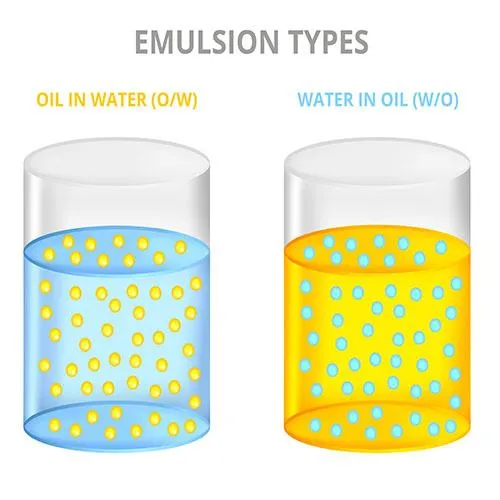
Emulsification: Surfactants stabilize fine droplets of oil in water (O/W) or water in oil (W/O), preventing coalescence during storage, dilution, and application. Emulsifiable concentrates (ECs) in crop protection rely on carefully balanced emulsifier systems that must remain stable from tropical warehouse temperatures to cold field dilution water.
Solubilization: Micelles dissolve fragrances, vitamins, essential oils, and lipophilic actives in clear aqueous products such as toners, mouthwashes, and pharmaceutical solutions. High-HLB nonionics like polysorbate 20 are common solubilizers in this role.
Dispersion: Surfactants adsorb onto pigment or clay particles, imparting charge or steric stabilization so solids remain suspended in paints, inks, and drilling fluids.
Four main classes of surfactants
Surfactants are classified by the charge on their hydrophilic head group in aqueous solution. Each class has distinct compatibility, foam profile, and application strengths.
Nonionic surfactants
Nonionic surfactants carry no electrical charge. Examples include fatty alcohol ethoxylates, polysorbates, polyethylene glycols, and EO/PO block copolymers. They are generally mild, electrolyte-tolerant, and widely used in agriculture, personal care, and industrial cleaning. Hydrophilicity is tuned by ethylene oxide mole count rather than ionic character. See our nonionic surfactants guide for a deeper treatment.
Anionic surfactants
Anionic surfactants carry a negative charge in water. Sulfates, sulfonates, carboxylates, and phosphate esters deliver strong detergency, wetting, and foaming — ideal for laundry, dishwash, and alkaline cleaners. They can be precipitated by hard-water calcium and magnesium ions and are incompatible with cationic ingredients in the same aqueous phase. Browse our anionic surfactants range.
Cationic surfactants
Cationic surfactants carry a positive charge. Fatty amine ethoxylates and quaternary ammonium compounds adsorb onto negatively charged surfaces such as hair, cotton, and metal. Applications include fabric softeners, antistatic agents, corrosion inhibitors, and disinfectants. Browse our cationic surfactants range and cationic surfactants guide.
Amphoteric surfactants
Amphoteric surfactants can carry positive, negative, or zwitterionic character depending on pH. Betaines and amphoacetates are valued in personal care for mildness, foam stabilization with anionics, and good skin compatibility in shampoos and facial cleansers. See our amphoteric surfactants range and amphoteric surfactants guide.
Choosing the right surfactant
Selection depends on substrate (skin, metal, cotton, crude oil), pH, electrolyte level, required foam, regulatory limits, biodegradability requirements, and target HLB for emulsions. Formulators often blend two or more classes — for example anionic plus nonionic in laundry liquids — to balance cost, foam, detergency, and mildness.
Venus Ethoxyethers manufactures all four classes from facilities in India and the United States, with over 30 years of experience in ethoxylation, propoxylation, esterification, and sulfonation. Our portfolio includes more than 1,600 products for agriculture, textiles, personal care, oil and gas, paper, metalworking, and pharmaceuticals. Our technical team supports customers with grade recommendations, custom ethoxylation levels, and sample supply.
Real-world application examples
| Industry | Surfactant type | Example use level | Outcome |
|---|---|---|---|
| Laundry liquid | C12–14 alcohol, 7 EO + LAS | 8–12% nonionic + 6–10% anionic | Grease removal in hard water |
| Herbicide spray | Silicone spreader + FAE | 0.1% + 0.2% | Full leaf coverage on waxy weeds |
| Shampoo | SLES + cocamidopropyl betaine | 10% + 3% | Foam + mildness balance |
| Crude oil treater | Demulsifier blend | 5–50 ppm | Water drop from oil phase |
| Tablet coating | PEG 4000 | 2–5% in coating dispersion | Smooth film, controlled release |
| Emulsion polymerization | C12–C16 alcohol ethoxylate | 1–3% on monomer | Stable latex particle size |
Troubleshooting surfactant selection
| Problem | Likely cause | First move |
|---|---|---|
| Poor grease removal in hard water | Anionic precipitated by Ca²⁺ / Mg²⁺ | Raise nonionic FAE share; check chelant |
| Cat–an cloud or sediment | Cationic mixed with anionic in water | Use amphoteric bridge or split phases |
| Foam too high in spray or CIP | High-foam anionic or mid-EO FAE | Low-foam or capped nonionic; defoamer last |
| Emulsion splits on heat age | HLB mismatch or ester hydrolysis | Retune blend HLB; check pH |
| Eye sting in rinse-off | High free anionic monomer | Lower SLES; add CAPB or amphoacetate |
Specify active %, pH, colour, and residual EO or 1,4-dioxane on ethoxylates when the grade is for personal care or pharma-adjacent use. Technical detergent surfactants are not automatically cosmetic-ready. Lock a small emulsion or foam check method when you dual-source so homologue drift shows up before a production batch.
Krafft temperature, cloud point, and packing
Two temperature-linked properties often decide whether a surfactant remains dissolved and useful. The Krafft temperature is the point above which an ionic surfactant's solubility rises sharply and micelles can form; below it, hydrated crystals may precipitate and cleaning collapses. Sodium alkyl sulfates and LAS are more Krafft-sensitive than many ether sulfates. Nonionics instead show a cloud point: as temperature rises, ethylene oxide chains dehydrate, the solution turns turbid, and detergency, foam, and emulsion type can shift. Formulators therefore specify cloud point against process water, electrolyte, and expected wash or spray temperature rather than treating HLB as the only selection number.
Micelle geometry is governed by the critical packing parameter — roughly the hydrophobic tail volume relative to head-group area and chain length. Cone-shaped molecules favour spherical micelles; more cylindrical packing favours rods and higher viscosity; inverted cones favour reverse micelles in oil. This is why a C12 ether sulfate thickens with salt while a highly ethoxylated nonionic may not, and why blending head-group sizes is a practical way to tune foam, rheology, and soil solubilization without changing the entire surfactant family.
Buy surfactants from a manufacturer in India
Venus Ethoxyethers manufactures nonionic, anionic, cationic, and amphoteric surfactants — ethoxylates, esters, sulfates, and specialty blends — with technical support, samples, and export documentation. Explore our product range, alkoxylates, surfactant types guide, surfactant manufacturer India guide, and request a quote.