Emulsifiers
O/W vs W/O Emulsions: Selection, HLB and Formulation Examples
Every stable emulsion is a thermodynamically metastable dispersion of one immiscible liquid in another, stabilized by surfactants and often co-emulsifiers, waxes, or polymers at the oil–water interface. The fundamental distinction — oil-in-water (O/W) versus water-in-oil (W/O) — governs skin feel, release of actives, sprayability, dilution behaviour, and regulatory classification in cosmetics, pharmaceuticals, and agrochemicals. Choosing the correct emulsion type is not guesswork: the Hydrophile–Lipophile Balance (HLB) system, required HLB of the oil phase, and phase volume ratio together give formulators a rational starting point before stability testing. Venus Ethoxyethers manufactures nonionic, anionic, and specialty emulsifiers across the full HLB range from ethoxylation facilities in Goa, India, and the United States, with more than 30 years of formulation support for personal care, industrial, and crop protection customers.
On this page
- What is the difference between O/W and W/O emulsions?
- How HLB predicts emulsion type
- Required HLB: calculating the target for your oil phase
- Phase volume ratio and the Bancroft rule
- Worked example 1: O/W cosmetic cream
- Worked example 2: W/O sunscreen emulsion
- Worked example 3: O/W body lotion
- Worked example 4: Agrochemical emulsifiable concentrate (EC)
- Stability factors beyond HLB
- Manufacturing and scale-up at Venus
What is the difference between O/W and W/O emulsions?
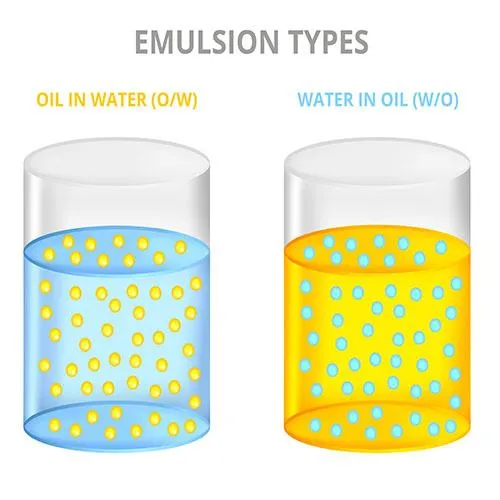
In an oil-in-water (O/W) emulsion, oil droplets are dispersed in a continuous aqueous phase. O/W systems feel lighter on skin, rinse easily with water, and are the default choice for lotions, milk-type cleansers, water-dilutable agrochemical concentrates, and most household cleaners. The external phase is water, so O/W emulsions conduct electricity poorly but more readily than W/O systems, and they generally accept water-soluble preservatives, hydrophilic thickeners, and electrolytes at moderate levels.
In a water-in-oil (W/O) emulsion, water droplets are dispersed in a continuous oil phase. W/O systems feel richer and more occlusive, resist wash-off, and are preferred for heavy night creams, barrier repair products, sunscreens targeting water resistance, and certain pharmaceutical ointments. Because the continuous phase is lipophilic, W/O emulsions tolerate higher electrolyte loads in the internal aqueous phase without the same inversion risk that salts impose on O/W systems — though they are harder to manufacture and require low-HLB emulsifiers.
The emulsion type is determined primarily by emulsifier chemistry (HLB), phase volume ratio, and processing conditions — not simply by which ingredient is present at higher weight percent. A formula with 60% water and 40% oil can still form W/O if the emulsifier system favours a lipophilic interfacial film. See our surfactant vs emulsifier guide for context on when emulsification rather than detergency is the primary surfactant function.
How HLB predicts emulsion type
The HLB scale, developed by William Griffin in the late 1940s, ranks surfactants from 0 (fully lipophilic) to 20 (fully hydrophilic). As a practical rule for nonionic emulsifiers:
- HLB 3–6: W/O emulsifiers — sorbitan monoesters, glycerol monooleate, low-EO castor oil ethoxylates
- HLB 8–18: O/W emulsifiers — polysorbates, fatty alcohol ethoxylates with 7+ EO, high-EO castor oil ethoxylates
- HLB 7–9: wetting and dispersing; may require blending for stable emulsions
Griffin's original calculation for ethoxylated nonionics relates HLB to the weight fraction of the hydrophilic portion. In modern formulating, published HLB values for commercial grades are blended arithmetically. Full background is in our HLB scale guide.
| HLB range | Emulsion type favoured | Example emulsifiers |
|---|---|---|
| 1–3 | Antifoam, W/O co-emulsifier | Sorbitan trioleate, lanolin derivatives |
| 4–6 | W/O primary emulsifier | Sorbitan oleate, glycerol monostearate, COE 5 EO |
| 8–12 | O/W (light), wetting | C12–14 alcohol 7 EO, polysorbate 60 |
| 12–16 | O/W (robust), solubilization | Polysorbate 80, C16–18 alcohol 10 EO |
| 15–18 | Solubilizer, micellar systems | Polysorbate 20, PEG-40 castor oil |
Required HLB: calculating the target for your oil phase
Each oil, wax, or lipophilic active has a required HLB — the system HLB at which it is most readily emulsified in an O/W system. When the emulsifier blend HLB matches the weighted required HLB of the oil phase, emulsions form more easily and tend toward better long-term stability. Required HLB values are determined experimentally; the table below lists representative guides for common ingredients.
| Oil / wax / active | Required HLB (O/W) | Notes |
|---|---|---|
| Mineral oil (light) | 10–11 | Standard cosmetic and pharma base |
| Vegetable oil (soy / sunflower) | 7–8 | Neem EC, salad dressing analogues |
| Castor oil | 14 | Agrochemical EC dilution |
| Isopropyl myristate | 11 | Cosmetic emollient emulsions |
| Beeswax | 9 | Structured creams and sticks |
| Silicone oil (350 cSt) | 10.5 | Polish and personal care emulsions |
| Paraffin wax | 10 | Industrial and candle emulsions |
| Octyl methoxycinnamate (OMC) | 11–12 | UV filter in sunscreen emulsions |
Step 1 — List the oil phase components and their weight fractions. Example: a cream oil phase containing 8% mineral oil and 2% cetyl alcohol.
Step 2 — Look up required HLB for each component. Mineral oil ≈ 10.5; cetyl alcohol ≈ 15.
Step 3 — Calculate weighted required HLB:
Weighted required HLB = (0.8 × 10.5) + (0.2 × 15) = 8.4 + 3.0 = 11.4
Step 4 — Blend emulsifiers to match. If using 70% Polysorbate 60 (HLB 14.9) and 30% Sorbitan stearate (HLB 4.7): System HLB = 0.7 × 14.9 + 0.3 × 4.7 = 10.4 + 1.4 = 11.8 — close to the target of 11.4.
For W/O emulsions, select emulsifiers in the 3–6 HLB range. The required HLB concept still applies but targets the lipophilic side. A W/O night cream might use sorbitan oleate (HLB ~4.3) as primary emulsifier with a small amount of polyglyceryl-3 diisostearate as co-emulsifier.
Phase volume ratio and the Bancroft rule
The Bancroft rule states that the phase in which the emulsifier is more soluble tends to become the continuous phase — which is why high-HLB surfactants favour O/W and low-HLB surfactants favour W/O. However, phase volume also matters: emulsions with more than 74% internal phase volume become thermodynamically difficult to stabilize as simple O/W or W/O and may require multiple emulsifiers or transition to high internal phase emulsion (HIPE) technology. Most cosmetic creams operate at 15–30% oil phase (O/W) or 60–80% oil phase (W/O), well within conventional formulating ranges.
Worked example 1: O/W cosmetic cream
Target: Medium-viscosity day cream, 20% oil phase, stable at 40°C for 12 weeks, suitable for export to EU and ASEAN markets.
Oil phase (20%):
- 10% mineral oil (required HLB ~10.5)
- 5% isopropyl myristate (required HLB ~11)
- 3% cetyl alcohol (co-emulsifier and bodying agent, required HLB ~15)
- 2% glyceryl stearate SE (secondary O/W emulsifier)
Weighted required HLB ≈ 11.2. Emulsifier blend: 3% Polysorbate 60 (HLB 14.9) + 1% Sorbitan stearate (HLB 4.7) → system HLB at 4% total emulsifier ≈ 12.1. Adjust ratio to 2.5% PS 60 + 1.5% sorbitan stearate if separation occurs during heat ageing.
Water phase (80%): deionized water, 0.3% xanthan gum (pre-dispersed), preservative system, 0.05% disodium EDTA, pH adjusted to 5.5 with citric acid.
Process: Heat oil and water phases separately to 75°C. Add water phase to oil phase with homogenizer at 3000–5000 rpm for 3 minutes. Cool to 40°C with sweep agitation. Add heat-sensitive actives below 40°C.
Venus supplies co-surfactants and emulsifiers including polysorbates, fatty alcohol ethoxylates, and sorbitan esters for cream formulations. See also cosmetic emulsifiers guide.
Worked example 2: W/O sunscreen emulsion
Target: Water-resistant SPF 50 sunscreen with occlusive skin feel, W/O type for beach and sport applications.
W/O sunscreens place UV filters in the continuous oil phase or at the interface, improving water resistance compared to equivalent O/W systems. The trade-off is heavier skin feel and more challenging manufacturing.
Oil phase (continuous, ~65%):
- 25% C12–15 alkyl benzoate (emollient solvent for UV filters)
- 15% mineral oil
- 10% octocrylene + 8% OMC (UV filters dissolved in oil phase)
- 4% sorbitan oleate (primary W/O emulsifier, HLB ~4.3)
- 2% polyglyceryl-3 polyricinoleate (W/O co-emulsifier)
- 1% hydrogenated castor oil (structure and water resistance)
Internal aqueous phase (~35%): water, 3% glycerin (humectant in internal phase), magnesium sulfate (0.5%, W/O stabilizer), preservative, 0.5% bis-ethylhexyloxyphenol methoxyphenyl triazine (water-soluble UV filter if required by regulation).
Process: Disperse magnesium sulfate in water phase at 75°C. Heat oil phase to 80°C to fully dissolve UV filters. Add water phase slowly to oil phase under high-shear homogenization — note reverse addition versus O/W. Cool with gentle stirring to preserve W/O structure.
Validate water resistance per ISO 16217 or regional equivalent. W/O systems tolerate electrolyte in the internal phase better than O/W systems tolerate salt in the continuous phase.
Worked example 3: O/W body lotion
Target: Pumpable body lotion, light skin feel, 12% oil phase, cost-optimized for mass market.
- 6% C12–14 alcohol, 7 EO (primary O/W emulsifier from Venus ethoxylated alcohol range — HLB ~12)
- 4% caprylic/capric triglyceride + 2% shea butter (oil phase)
- 0.5% cetyl alcohol (viscosity and stability)
- 0.2% carbomer (pre-neutralized to pH 5.5–6.0 for gel-network stability)
Single-emulsifier O/W lotions are feasible when oil phase required HLB aligns with the chosen FAE HLB. C12–14, 7 EO at 6% emulsifies a 12% oil phase with required HLB ~8–9 comfortably. Homogenize at 70°C, cool through 50°C while adding fragrance pre-solubilized in 0.3% castor oil ethoxylate (COE-40).
Lotion viscosity is controlled by carbomer gel network plus cetyl alcohol crystallinity — not by emulsifier alone. Target Brookfield viscosity 3000–8000 cP at 25°C for pump delivery.
Worked example 4: Agrochemical emulsifiable concentrate (EC)
An EC is not a pre-made emulsion but a solvent-based concentrate that spontaneously emulsifies when poured into water in the spray tank, forming an O/W emulsion in the field. Emulsifier selection follows the same HLB logic applied to the solvent plus active ingredient blend.
Target: 25% cypermethrin EC in aromatic solvent, CIPAC-compliant dilution stability at 1:500 in 342 ppm hardness water.
- 8% C9–C11 alcohol, 5 EO (nonionic emulsifier, HLB ~10)
- 4% calcium dodecylbenzene sulfonate (anionic emulsifier and wetting aid)
- 25% cypermethrin technical
- Balance Solvesso 100 aromatic solvent
The emulsifier package (12% total) targets system HLB 10–12 for the solvent/active blend. Anionic–nonionic pairing improves hard-water stability and reduces creaming at low temperature. Total emulsifier requirement is higher than in pre-made cosmetic emulsions because the EC must self-emulsify without homogenization.
Test per CIPAC 36.1: dilute at 1:500 in standard waters, hold at 0°C, 20°C, and 54°C for 24 hours — no oil separation or cream layer. See our emulsifiable concentrates guide and agrochemical applications page.
Stability factors beyond HLB
HLB matching is necessary but not sufficient. Formulators must also evaluate:
- Temperature: Nonionic emulsifiers lose hydrophilicity above cloud point, which can invert or break emulsions at high storage temperature.
- Electrolytes: Salt in the continuous phase of O/W emulsions compresses the double layer and promotes coalescence.
- pH: Ester-based emulsifiers (sorbitan esters, polysorbates) hydrolyse at extreme pH; ionic emulsifiers change charge state.
- Co-emulsifiers and waxes: Cetyl alcohol, beeswax, and glyceryl stearate build a gel network in the interfacial region that improves stability beyond HLB prediction.
- Phase inversion temperature (PIT): For ethoxylated nonionics, formulating near the PIT during production can yield fine droplet size; see our HLB guide for PIT context.
Manufacturing and scale-up at Venus
Venus Ethoxyethers produces emulsifier raw materials — fatty alcohol ethoxylates, castor oil ethoxylates, polysorbates, sorbitan esters, and custom blends — from dedicated ethoxylation reactors in Goa, India. Batch controls include mole-ratio targeting, cloud point verification, and residual EO stripping. With 90,000 MT group manufacturing capacity and 24/7 R&D, Venus supports custom EO levels, HLB-targeted blends, and toll ethoxylation for formulators developing O/W and W/O systems.
Explore the full emulsifiers range, polysorbate grades, and personal care applications. Request samples, TDS, and HLB matching support via contact Venus Ethoxyethers.